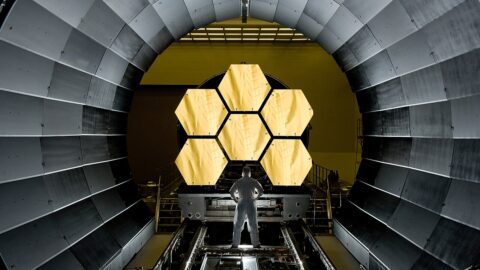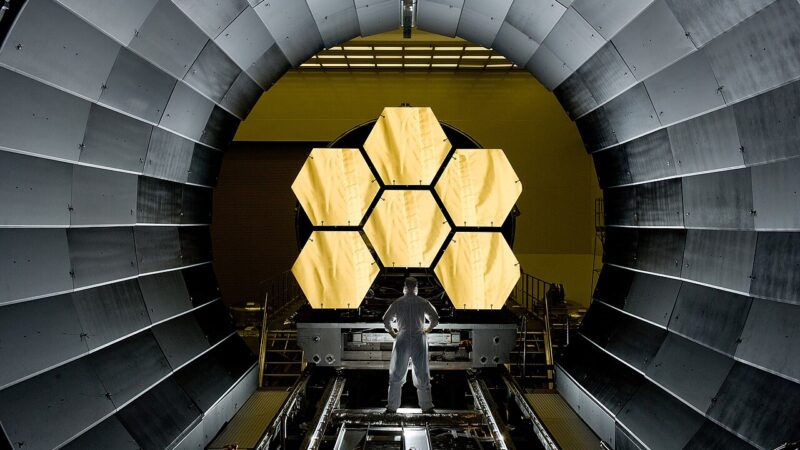
Dust around young stars is teaching astronomers to read collisions they can never watch. In a study of 21 extreme debris disks published October 2, 2026, researchers using the James Webb Space Telescope and archived Spitzer data sorted the wreckage into two chemical families — silica-rich dust from head-on collisions violent enough to vaporise rock, and silica-poor dust from gentler, grazing impacts — according to the published reporting.
Extreme debris disks are rare — found around only about 1 percent of young stars in the agency’s description — and they are the smoke of recent planetary collisions, glowing in mid-infrared light. The team’s forensic tool is mineralogy. When Mars-sized bodies collide at hypervelocity, rock vapour condenses into silica-rich grains chemically akin to volcanic glass; when Moon-sized bodies graze, the debris stays richer in crystalline silicates such as forsterite. About a third of the sample is silica-rich, in the study’s account, and silica-rich systems appear only around stars younger than about 300 million years — matching simulations in which the giant-impact era of planet-building burns itself out within a few hundred million years.
Earth is the calibration sample. The leading account of the Moon’s origin has a Mars-sized body, Theia, striking the infant Earth and blasting rock into orbit — an event that would have written, around the young sun, exactly the silica-rich signature Webb now reads around other stars. “To just see their mid-infrared emission and beautiful spectral features with Webb… was the most exciting thing,” one co-author is quoted in the agency release, adding that there is no other way to study these planetary embryos directly. The senior author makes the connection explicit in the same coverage: how rocky planets formed and giant planets evolved is one story, and extreme debris disks are its surviving chapters.
The hypothesis now has a testable edge. If silica-rich disks truly require youth, older extreme disks — three in the current sample fit that age, all silica-poor — should never show the vaporised signature, and the next observing campaigns will either confirm the pattern or break it. The team is candid about the sample’s limits; 21 systems is a beginning, not a census.
Four and a half billion years ago, the sky over the half-molten Earth held the debris of the collision that made the Moon. For the first time, astronomers can point a telescope at somebody else’s version of that sky — and read, in glass dust, whether their worlds, too, were built by catastrophe.
Related reading: