A Jupiter-sized planet orbiting a star too small to have built it has yielded the second-ever detection of ammonia in a distant world’s atmosphere — and temperatures far colder than its orbit should allow — in Webb observations published September 8, 2026, according to the research team’s reporting.
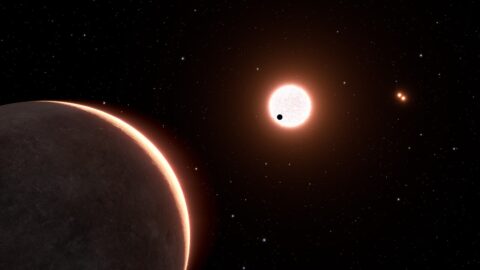
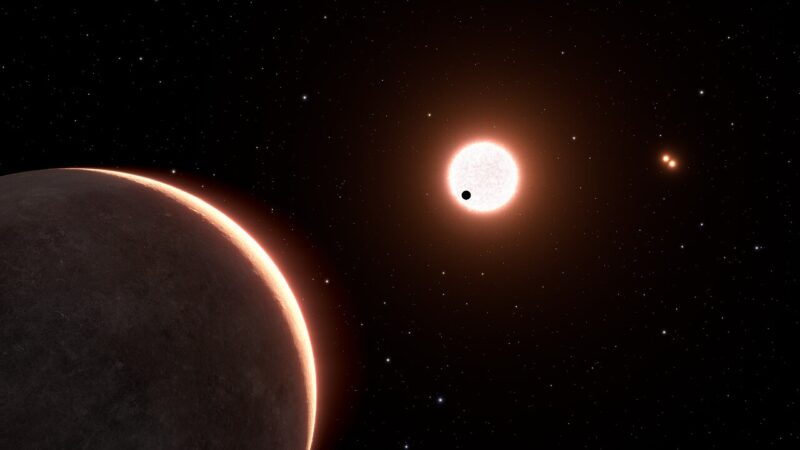
HATS-6 b circles an M dwarf — a small, cool, red star — about 500 light-years away, completing an orbit every three days. By transmission spectroscopy, watching starlight filter through the planet’s atmosphere, the University of Maryland-led team identified water, methane, ammonia and carbon dioxide. Ammonia is the prize: nitrogen-bearing molecules survive preferentially in cooler giants, so its presence supports the theory that giants around small stars are a chemically distinct population — and the detection is only the second by this technique on any distant world, in the team’s account.
The planet should, by the standard story, not exist. Small stars leave small disks of gas and dust; small disks should not assemble a Jupiter. “These smaller stars don’t have enough material or enough time to create planets as big as Jupiter and as big as Saturn,” the study’s lead author, doctoral researcher Giannina Guzmán Caloca, is quoted, “so the fact that HATS-6 b can exist is really interesting because it shouldn’t be possible with what we know.” Only about 40 such giants are known around M dwarfs; HATS-6 b is one of seven being examined by the dedicated Webb programme, GEMS, designed to compare these outliers against giants of sun-like stars.
The unexpected chill deepens the puzzle. The planet reads significantly cooler than equilibrium calculations predict for its three-day orbit, suggesting — in the team’s careful phrasing — that its relationship with its star is more complicated than the models assume: perhaps atmospheric circulation redistributing heat, perhaps composition, perhaps a formation history that started farther out. Each explanation rewrites a different chapter of giant-planet theory, which is why the programme measures atmospheres rather than merely counting anomalies.
Exoplanet science advances by census and by character study. The census says giants around tiny stars are rare; HATS-6 b’s character — ammonia-bearing, under-heated, Jupiter-massed around a ember of a star — says rare does not mean marginal. The rulebook for how planets form was written around sun-like stars. The exceptions, one spectrum at a time, are revising it.
Related reading: